Understanding Object-Oriented Programming in JavaScript

As programs grow bigger and more complex, organizing code becomes very important. Writing everything in one place quickly becomes messy and hard to maintain.
In this particuler blog we discuss about most widely and real world relatable programming paradigm so before moving on topic first understand what is programming paradigm.
Programming paradigm
Programming paradigm is nothing but way of writing the code, like functional programming paradigm, procedural programming paradigm, object oriented programming paradigm.
Understand with a small example suppose we want to add two number.
// procedural programming paradigm
let a = 10;
let b = 30;

let c = a + b;
console.log(c);

// functional programming paradigm
function add(a, b){
 return a + b;
}

let res = add(5, 8);
console.log(res);

// Object Oriented programming paradigm we in below
Real world problem
Imagine you are building a system to manage students in a college.
Each student has:
name
age
course
roll number
If we write code without proper structure, we might end up doing something like this or follow other programming paradigm
let student1Name = "Rahul";
let student1Age = 20;
let student1Course = "CSE";

let student2Name = "Vishal";
let student2Age = 21;
let student2Course = "IT";
Now imagine managing 100 students like this.
Problems appear quickly:
Too many variables
Hard to manage data
Difficult to reuse logic
Code becomes messy
We need a better way to represent real-world entities in programming.
Introducing Object-Oriented Programming (OOP)
Object-Oriented Programming solves this problem by organizing code around objects.
Instead of thinking only about functions, we start thinking about things (objects) real world entity.
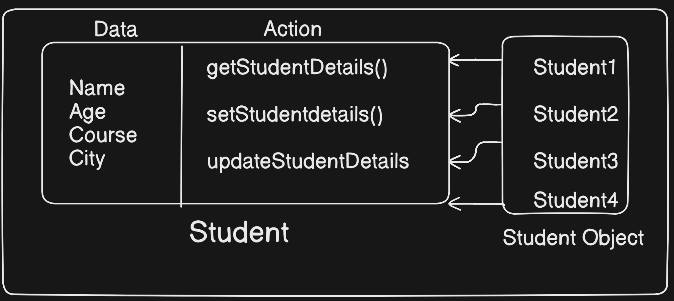
For example:
- Student
Each object contains:
Properties → data
Methods → actions
This approach makes programs more organized and easier to maintain.
Understand Class and Object
What is class?
A class is a blueprint or template used to create objects, It defines what properties and methods an object will have.
Class is like user datatype , so creating a class no such memory is allocate.
Example - Student, Car, Person..etc
class Student {
// properties & methode
}
What is Object?
An object is an instance of a class, It is the actual thing created using the blueprint.
We can create multiple object using same class and when object is create then only memory is allocate and reference is assign to variable.
let student1 = new Student();
Constructor in JavaScript
A constructor is a special method used to initialize objects when they are created.
It runs automatically when a new object is created or instantiated. and constructor is created by using constructor keyword.
class Student {
 // construtor creation
  constructor(name, age) {
    this.name = name;
    this.age = age;
  }
}

// creating object
let student1 = new Student("Vishal", 21);

console.log(student1.name);
// Output - "Vishal"
Example: Complete OOP Structure
class Student {

  constructor(name, age, course) {
    this.name = name;
    this.age = age;
    this.course = course;
  }

  introduce() {
    console.log(`Hi, my name is ${this.name}`);
  }

}

let student1 = new Student("Vishal", 21, "Computer Science");

student1.introduce();

// Output
"Hi, my name is Vishal"
Pillars of Object-Oriented Programming
There are four principal of object oriented programming called as piller of OOPS.
Encapsulation
Abstraction
Inheritence
Polymorphism
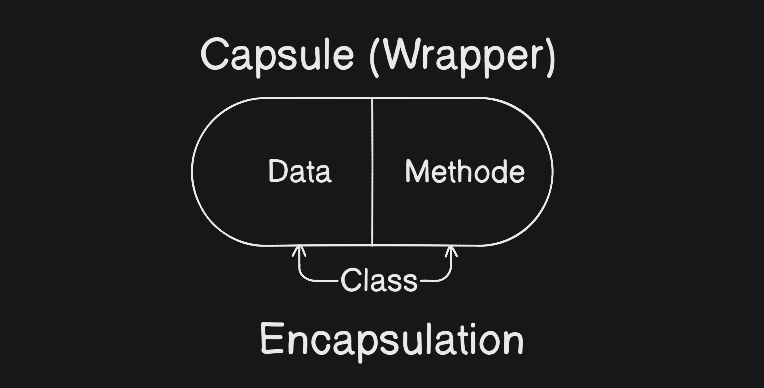
Encapsulation
Encapsulation means bundling data and methods together inside a class, or its wrap the data member and member function are wrap into single class.
It helps protect data and control how it is accessed.
Abstraction
Abstraction means hiding complex details and showing only what is necessary.
Basically in OOPs we keep all the data member inside private and all the methode are public so that from outside we can access data via methode not directly.
Example
When you drive a car, you only use:
steering
accelerator
brake
You don't need to know how the engine works internally.
Conclusion
Object-Oriented Programming (OOP) helps us organize code by modeling real-world entities using classes and objects. Instead of writing scattered variables and functions, we structure programs around data (properties) and behavior (methods). Concepts like constructors, encapsulation, and abstraction make code more manageable and easier to scale. By understanding these fundamentals, you build a strong foundation for writing cleaner and more maintainable JavaScript applications.


